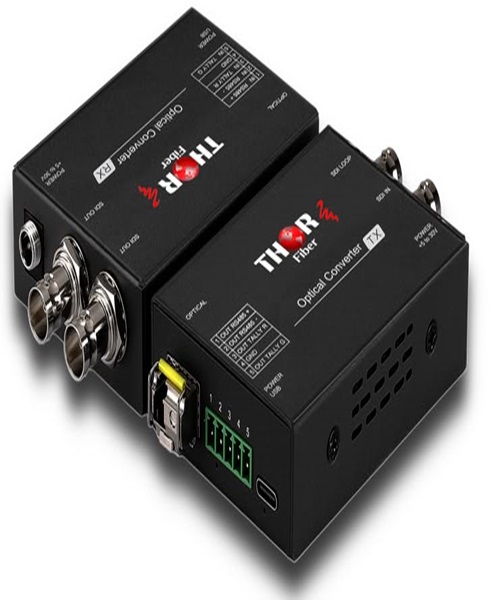
Fiber Video Transmission System Hire and Rental in Kenya – Long-Distance Professional Video Connectivity
Professional video productions sometimes require cameras and video equipment to be positioned far apart. A camera may be located on a stage while the production control area is positioned at the opposite end of a venue. During an outdoor broadcast, cameras may be positioned across a stadium, concert ground or public event space, with the main production equipment located in a control room or outside broadcast vehicle. Running conventional video cables over these distances can introduce practical and technical challenges.
A fiber video transmission system provides a professional solution for transporting video signals over long distances using optical fibre. Instead of carrying information through electrical signals along traditional copper conductors, fibre-based systems transmit information as light through optical cables. This makes them useful for demanding video production environments that require long cable runs, high bandwidth and resistance to electromagnetic interference.
At Janeson Rentals, we provide audiovisual equipment hire and rental solutions for conferences, broadcasts, filming, corporate events, live productions and professional video installations in Kenya. Our fiber video transmission system hire service is suitable for production companies, broadcasters, event organisers and technical teams that need dependable long-distance video connectivity.
Whether you are organising a large conference in Nairobi, producing a live concert, filming an outdoor event or connecting cameras across a large venue, a fibre video transmission setup can help connect your production equipment efficiently.
If you are searching for fiber video transmission system hire in Kenya, fibre optic video transmission rental in Nairobi, or professional long-distance video transmission equipment, Janeson Rentals can help you plan your equipment requirements.
What Is a Fiber Video Transmission System?
A fiber video transmission system is a group of compatible devices and optical cables used to transport video signals over fibre optic connections.
A typical system may include:
- A video source, such as an SDI or HDMI camera.
- A compatible video-to-fibre transmitter.
- Fibre optic cable.
- A fibre-to-video receiver.
- A compatible monitor, video switcher, recorder or other receiving device.
The transmitter converts or prepares the incoming video signal for optical transmission. The signal travels through the fibre cable to the receiving unit, which converts it back into a compatible video output.
Some professional cameras and production devices have integrated optical interfaces, while other setups require separate transmitter and receiver units.
Fibre systems can support different video formats and transmission protocols depending on the equipment. These may include SDI, HDMI and other professional video transport technologies.
The correct system depends on the source connections, destination connections, supported resolution, cable type and required transmission distance. Optical fibre is widely used in professional production environments where long cable runs and high-capacity signal transport are required.
How Does a Fiber Video Transmission System Work?
A fibre video transmission system works by converting video information into optical signals and transporting those signals through fibre optic cable.
The process generally involves four stages.
1. Video signal input
The source device supplies a video signal through a compatible connection. This may be an SDI output from a broadcast camera or an HDMI output from a compatible video device.
2. Optical conversion
The transmitter converts the electrical video signal into an optical signal using compatible conversion hardware or an optical interface.
3. Fibre transmission
The optical signal travels through the fibre optic cable to the receiving location. Fibre can support long-distance transmission, with the achievable distance depending on the optical equipment, fibre type, connectors and system design.
4. Signal reception and conversion
The receiver converts the optical signal back into a compatible video output. The receiving device can then send the signal to a monitor, switcher, recorder, streaming system or other production equipment.
This arrangement allows production teams to position video sources and receiving equipment farther apart without relying entirely on long copper video cables.
Why Hire a Fiber Video Transmission System from Janeson Rentals?
A fibre video transmission system may be needed for a specific broadcast, conference, concert, film shoot or temporary installation. Purchasing a complete fibre setup for occasional use can be expensive, particularly when the project requires specialised transmitters, receivers and optical cabling.
Hiring provides access to the equipment for the required production period without the responsibility of permanent ownership.
Benefits of fiber video transmission system rental include:
Long-distance connectivity: Fibre-based transmission can connect equipment over distances that may be difficult to manage with conventional copper video cabling.
High-capacity signal transport: Suitable professional fibre systems can support demanding video formats and production workflows.
Reduced electromagnetic interference: Optical fibre is not susceptible to electromagnetic interference in the same way as conventional electrical copper video cabling.
Flexible production layouts: Cameras and receiving equipment can be positioned in different areas of a venue or production location.
Temporary equipment access: Hiring is practical for one-time events, broadcasts, filming projects and installations.
Coordinated production equipment: You can plan your fibre transmission requirements alongside SDI cameras, monitors, video switchers, converters and recording systems.
Applications of Fiber Video Transmission System Rental in Kenya
1. Television and Broadcast Production
Broadcast production often requires video signals to travel between cameras, control rooms, studios and outside broadcast facilities.
A fibre video transmission system can connect cameras positioned far from the main production area. This is particularly useful for television studios, remote production locations and large broadcast environments.
The system can transport compatible camera signals to production switchers, monitors and recording devices.
2. Stadiums and Sporting Events
Large stadiums and sporting venues may have cameras positioned at different locations around the playing area.
Running conventional cables across long distances can be complicated, particularly when the production requires multiple camera positions.
Fibre video transmission can provide a suitable connection between remote camera locations and a central production area.
It is useful for sports broadcasts, tournaments, athletics competitions, live entertainment and large outdoor events.
3. Concerts and Live Entertainment
Concerts and festivals frequently use cameras positioned around the venue to capture performers, audience reactions and stage activities.
The production control area may be located far from the stage or camera positions.
A fibre video transmission system can help transport camera feeds to the video control area, where operators can monitor, switch, record and distribute the footage.
4. Corporate Conferences and Large Events
Large corporate events may use cameras positioned at the back of a conference hall, on stage, in breakout rooms or in other parts of a venue.
A fibre-based setup can connect remote camera positions to the main production area.
This is useful for conferences, business forums, product launches, award ceremonies, annual general meetings and hybrid events.
5. Outdoor Broadcasting
Outdoor productions may require video signals to travel between cameras, production vehicles and temporary control areas.
Fibre transmission can support long-distance connections in suitable production environments. The cable route and equipment must be planned to protect the fibre from excessive bending, crushing and physical damage.
6. Film and Television Production
Film crews may position cameras across large locations, including outdoor sets, production compounds and remote monitoring areas.
Fibre-based video transmission can help deliver camera signals to video village, director monitoring positions and recording facilities.
This is useful when conventional copper cable distances are unsuitable for the production layout.
7. Houses of Worship and Large Religious Events
Large churches and religious venues may use several cameras to capture services, conferences and special programmes.
Some cameras may be positioned far from the main technical booth. Fibre transmission can help connect these cameras to the control area for switching, recording and livestreaming.
8. Educational Institutions and Large Campuses
Universities, colleges and training institutions may use professional video systems across auditoriums, lecture halls and large campuses.
Fibre transmission can support long-distance connections between cameras, control rooms, presentation spaces and recording facilities.
Important Features to Consider When Hiring a Fiber Video Transmission System
Not every fibre transmission system supports the same video formats, optical connectors or distances. Before arranging a rental, consider the following requirements.
Video Signal Compatibility
Identify the video signal coming from your source device.
Common professional connections include SDI and HDMI. The transmitter must accept the source signal, and the receiver must provide an output compatible with the destination equipment.
A system designed for SDI over fibre should not automatically be assumed to accept HDMI directly without suitable conversion.
Resolution and Frame Rate
The system must support the required video resolution and frame rate.
Production workflows may involve HD, Full HD or 4K video, depending on the cameras, monitors and other equipment.
Confirm the complete system’s supported formats, including the transmitter, receiver and optical interface.
Single-Mode and Multi-Mode Fibre
Fibre optic cables are available in different types.
Single-mode fibre is commonly used for longer-distance optical transmission. Multi-mode fibre is often used for shorter-distance applications within buildings or facilities, depending on the equipment.
The transmitter, receiver and cable must be compatible. Never assume that a single-mode optical device will work with a multi-mode cable or vice versa.
Optical Connectors
Fibre systems may use different optical connector types. The connectors must match the transmitter, receiver and cable infrastructure.
Common connector families include LC and SC. Some professional equipment uses other specialised optical interfaces.
Transmission Distance
The required distance between the source and receiving equipment should be established before selecting the system.
Actual transmission distance depends on the optical transmitter, receiver, fibre type, connector quality, optical budget and installation conditions.
Number of Signals
Some fibre systems transport one video signal, while others can carry several signals through a multi-channel arrangement.
If your production uses multiple cameras, confirm the number of optical links or channels required.
Signal Format and Optical Interface
Some systems use dedicated optical transmitters and receivers, while others use compatible SFP or SFP+ modules and integrated optical interfaces.
The equipment must support the required video protocol and optical specifications.
Cable Protection and Installation
Fibre cables require careful handling. Avoid sharp bends, crushing, pulling beyond recommended limits and contamination of connector ends.
For live events, route cables safely and protect them from foot traffic, vehicle movement and accidental disconnection.
Fiber Video Transmission vs SDI Extender
An SDI extender is designed to extend an SDI video signal beyond the normal limitations of a direct connection using a compatible transmission method.
A fibre video transmission system specifically uses optical fibre as the transport medium. It may carry SDI or another supported video format depending on the transmitter and receiver.
Some SDI extenders are fibre-based, meaning the two product categories can overlap. However, not every SDI extender uses fibre, and not every fibre video transmission system is limited to SDI.
For a production requiring a long-distance optical connection, specify the source format, destination format and cable distance before choosing the equipment.
Fiber Video Transmission vs SDI Distribution System
An SDI distribution system manages the distribution of SDI signals to multiple destinations. It may include distribution amplifiers, splitters, routers, cables and other signal management equipment.
A fibre video transmission system focuses on transporting video signals through optical fibre between locations.
A production may use both technologies. For example, a camera feed can travel over fibre to a central control room and then be distributed to several monitors using an SDI distribution amplifier.
Fiber Video Transmission vs Wireless Video Transmission
Fibre video transmission uses a physical optical cable to carry video signals between devices.
Wireless video transmission sends video through a radio-frequency connection without requiring a continuous physical video cable between the transmitter and receiver.
Fibre is useful when a cable route can be installed and a stable long-distance connection is required. Wireless transmission is useful when camera movement, temporary layouts or physical cable restrictions make a wired connection impractical.
The choice depends on the production environment, required distance, mobility, latency, signal format and available infrastructure.
Related Equipment to Hire Alongside a Fiber Video Transmission System
Depending on your production, you may also need:
- SDI cables: For connecting cameras and other SDI equipment to compatible optical transmitters.
- SDI converters: For converting between supported video signal formats.
- HDMI converters: For integrating compatible HDMI sources and destinations.
- SDI distribution systems: For distributing received SDI signals to multiple destinations.
- SDI matrix: For routing multiple SDI sources to different outputs.
- Video router: For managing professional video signal paths.
- Video switcher: For switching between multiple camera feeds.
- Production monitors: For viewing and evaluating video signals.
- Field monitors: For camera-side monitoring.
- Video capture cards: For connecting compatible video feeds to computers.
- Streaming encoders: For preparing video signals for online broadcasts.
- Professional cameras: For capturing the video sources.
- Camera accessories: For supporting production and monitoring workflows.
Fiber Video Transmission System Hire in Nairobi and Across Kenya
Janeson Rentals is based in Nairobi and provides audiovisual equipment hire solutions for clients across Kenya.
Our fiber video transmission system rental service is suitable for production companies, broadcasters, corporate event organisers, churches, educational institutions and technical teams working on large audiovisual projects.
When requesting a quotation, provide:
- The video source connection, such as SDI or HDMI.
- The destination connection required.
- The number of video signals to be transmitted.
- The approximate cable distance.
- Whether single-mode or multi-mode fibre is already available.
- The required resolution and frame rate.
- The event date and production location.
These details help establish the appropriate equipment configuration and identify any additional accessories required.
Why Choose Janeson Rentals?
Janeson Rentals provides equipment hire solutions for event organisers and production teams that need professional audiovisual equipment in Kenya.
Clients choose Janeson Rentals for:
Professional AV equipment solutions: We support conferences, broadcasts, filming, live events and corporate productions.
Flexible rental arrangements: Hiring is suitable for temporary productions that require specialised fibre transmission equipment.
Related equipment coordination: You can plan fibre transmission alongside cameras, SDI equipment, monitors, converters and video switchers.
Kenya-focused service: Based in Nairobi, Janeson Rentals serves clients organising events and productions across Kenya.
Equipment planning: Sharing your technical requirements helps identify the right transmission configuration for your production.
Book Fiber Video Transmission System Hire and Rental in Kenya Today
A fibre video transmission system is an effective solution for professional productions that need to transport video signals over long distances. It can support broadcast studios, concerts, stadiums, conferences, film shoots, outdoor productions and large audiovisual installations.
Janeson Rentals provides fiber video transmission system hire and rental solutions for clients in Nairobi and across Kenya.
Contact Janeson Rentals to enquire about fibre video transmission equipment for your next production. Share your video format, required distance, number of signals and event location so that the appropriate equipment can be planned.
Choose Janeson Rentals for professional audiovisual equipment hire and create a more flexible long-distance video production setup.